Prebiotic Sodas and IBS: Are They Safe for a Sensitive Gut?
This is a guest blog from one of our dietetic interns, Indigo Robinson, written in collaboration with Samina Qureshi, RDN, LD, CSDH.
If you live with irritable bowel syndrome (IBS) or another digestive condition, you have probably seen prebiotic sodas promising better digestion and a happier gut. But if you have a sensitive gut, more fiber is not always better, and sometimes it can make symptoms worse.
I want to walk you through what prebiotic sodas actually are, what fiber does in the body, and whether these trendy drinks truly fit into life with a sensitive gut.
As someone who has lived with IBS for six years, I understand what it feels like to get excited about the latest food trend while wondering if my gut will let me enjoy it without pain or distress. I want to be able to try a wide variety of foods, which is why it matters so much to understand what is actually in what we eat and whether it might trigger GI symptoms.
What Are Prebiotic Sodas?
Prebiotic sodas are fizzy drinks with added fibers like inulin and fructooligosaccharides, or FOS. These fibers feed your gut bacteria, but they are also the same types of fibers found in foods that commonly trigger IBS symptoms, including onion, garlic, wheat, and certain fruits.
You may have heard of fermentable carbohydrates like FODMAPs (Fermentable Oligosaccharides Disaccharides Monosaccharides and Polyols) . This is a group of carbohydrates that extensive research has linked to common IBS symptoms such as stomach pain, diarrhea, constipation, and gas. That does not automatically make them bad. It simply means some guts notice them more than others.
Why Prebiotic Fibers Can Be Tricky for IBS
When prebiotic fibers reach your large intestine, your gut bacteria ferment them. Fermentation is essentially your gut breaking these fibers down, and it is a completely normal part of digestion. For some people, that process feels like mild fullness or nothing at all. For others, especially those with a sensitive gut, it can bring abdominal pressure, cramping, bloating, and urgency.
Because these drinks are also carbonated, you are combining fiber with fizz, which can intensify how your gut feels afterward. This reaction varies widely from person to person, and plenty of people sip these sodas with no issues at all.
Research supports this pattern. Short, fast-fermenting fibers like inulin often cause bloating and discomfort in people with IBS, while longer-chain fibers like psyllium ferment more slowly and tend to be better tolerated. Understanding this difference between fiber types is important for anyone managing IBS or a sensitive gut.
What the Research Says
Not all fiber is created equal. Fibers react differently once they reach the gut. Psyllium ferments slowly and tends to cause less distress, while inulin can lead to quicker gas buildup and bloating for some people.
Prebiotics still matter. No matter how sensitive your gut is, feeding your gut bacteria is still valuable. Working with a GI dietitian can help you find low FODMAP fiber sources, such as chia seeds, peanuts, green beans, quinoa, and pumpkin seeds, that support your gut without triggering significant distress.
An individualized approach is essential. Everyone experiences IBS differently, and your tolerance for fiber depends on your unique gut and lifestyle. Many commercially available prebiotic products contain small enough amounts of prebiotics to limit GI discomfort, but they may also be too small to provide meaningful health benefits. There is no single approach that works for everyone navigating prebiotic sodas with IBS or another digestive condition.
What an IBS Dietitian Sees in Practice
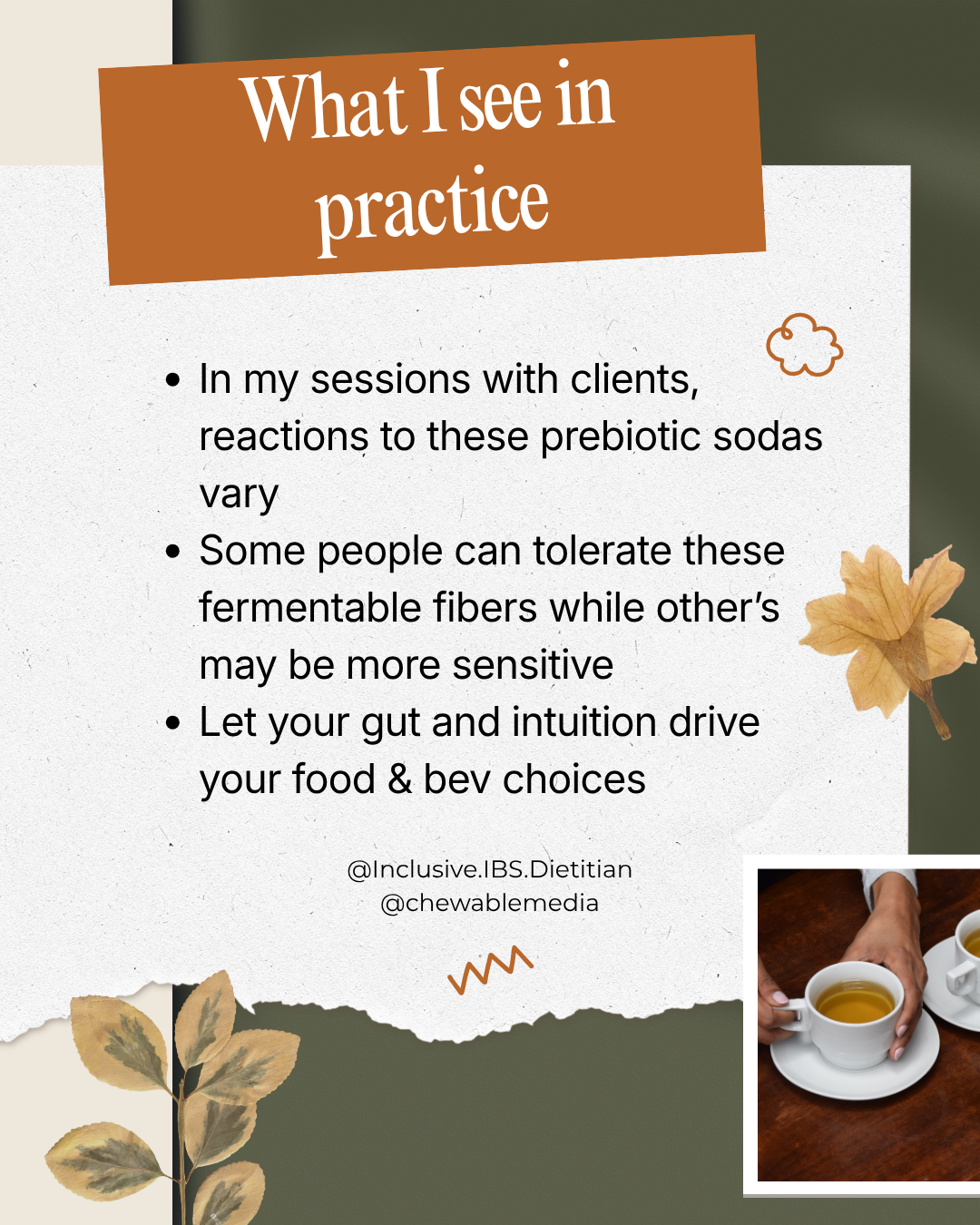
I spoke with Samina Qureshi, RDN, LD, CSDH, who works regularly with IBS patients at Wholesome Start Nutrition Counseling. Her approach to IBS care centers on evidence-based nutrition, a weight-inclusive philosophy, and personalized support that accounts for the many factors influencing digestive health, including eating patterns, stress, and lifestyle habits. She sees prebiotic sodas come up often in her sessions, especially as they have gained popularity on social media.
Here is what she shared with me.
Everyone's gut reacts differently. Samina treats this on a case by case basis. Some patients tolerate prebiotic sodas with no issues, while others experience real gastrointestinal distress.
IBS-C and IBS-D often respond differently. Patients with IBS-C, the constipation-predominant type, often experience more belly pain, gas, and bloating, since a slower GI tract can trap the gas produced during fermentation. Patients with IBS-D, the diarrhea-predominant type, more often notice increased bowel frequency and urgency after drinking prebiotic sodas or consuming a large amount of fiber at once. Samina was clear that these are patterns seen in practice, not rules that apply to everyone.
She does not automatically recommend prebiotic sodas. Samina would not suggest them as a first-line option, especially for someone in an active flare. But for a curious patient in a stable place, she takes a different approach. In her words, if a patient wants to try one, she helps them do it in a way that feels safe, taking it slow, since the reaction really depends on the person.
The takeaway from our conversation is simple. Your gut is unique, your reaction is valid, and your tolerance may not look like anyone else's. If you have a sensitive gut, remember this: you are not doing anything wrong if prebiotic sodas make you uncomfortable, and you are not doing anything unusual if you tolerate them just fine. Your gut's response is information, not a personal failure.
If You Want to Try One Anyway
That is completely fair. These drinks are trendy and fun, and curiosity is normal. Here is how to make it easier on your gut:
Start with a few sips rather than a whole can
Avoid drinking one on an empty stomach
Choose flavors with less added inulin or chicory root fiber
Consider skipping it during a flare
Skip it altogether if you are in the middle of a food elimination diet for IBS
Pay attention to how your body responds
Your gut will tell you everything you need to know.
The Bottom Line
Prebiotic sodas are not bad. They are simply one tool, and like any tool, they work well for some people and not as well for others. If you love them and tolerate them well, that is great. If they leave you feeling miserable, you are not doing anything wrong. Your gut is simply sensitive to the type of fibers in the beverage, and that is okay. There are plenty of other ways to support your gut microbiome that do not involve bloating or bathroom emergencies. Your comfort matters more than any wellness trend.
Want Personalized Guidance for Your Gut?
Navigating IBS and fiber tolerance is not something you have to figure out alone. If you would like a fully personalized plan built around your body, your triggers, and your life, book a free 15-minute discovery call with Samina Qureshi, RDN, LD, CSDH, to see if 1:1 support is the right fit for you.
References
Bedu-Ferrari, C., Biscarrat, P., Langella, P., & Cherbuy, C. (2022). Prebiotics and the human gut microbiota: From breakdown mechanisms to the impact on metabolic health. Nutrients, 14(10), 2096.https://doi.org/10.3390/nu14102096
El-Salhy, M., Ystad, S. O., Mazzawi, T., & Gundersen, D. (2017). Dietary fiber in irritable bowel syndrome (review). International Journal of Molecular Medicine, 40(3), 607–613.https://doi.org/10.3892/ijmm.2017.3072
Hughes, R. L., Alvarado, D. A., Swanson, K. S., & Holscher, H. D. (2021). The prebiotic potential of inulin-type fructans: a systematic review. Advances in Nutrition, 13(2).https://doi.org/10.1093/advances/nmab119
Monash University. (2019). FODMAP food list. Monashfodmap.com.https://www.monashfodmap.com/about-fodmap-and-ibs/high-and-low-fodmap-foods
Roy, S., & Dhaneshwar, S. (2023). Role of prebiotics, probiotics, and synbiotics in management of inflammatory bowel disease: Current perspectives. World Journal of Gastroenterology, 29(14), 2078–2100.https://doi.org/10.3748/wjg.v29.i14.2078
Sheng, W., Ji, G., & Zhang, L. (2023). Immunomodulatory effects of inulin and its intestinal metabolites. Frontiers in Immunology, 14, 1224092.https://doi.org/10.3389/fimmu.2023.1224092
Yoo, S., Jung, S.-C., Kwak, K., & Kim, J.-S. (2024). The role of prebiotics in modulating gut microbiota: Implications for human health. International Journal of Molecular Sciences, 25(9), 4834.https://doi.org/10.3390/ijms25094834